
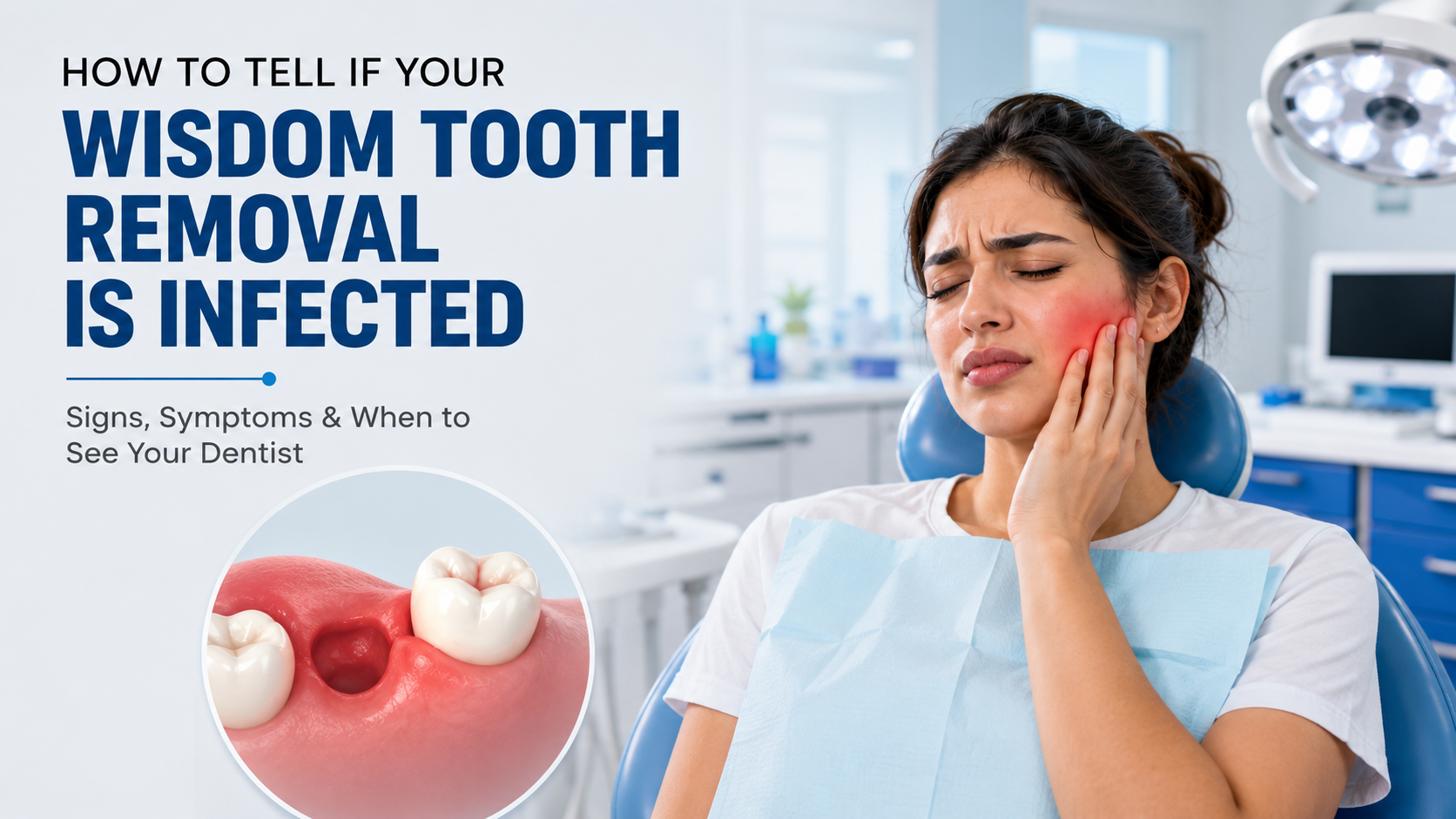
How to Tell If Your Wisdom Tooth Removal Is Infected
Day four after your extraction. The pain has not improved, the swelling looks the same or worse, and there is a taste in your mouth you cannot rinse away. So: how do I know if my wisdom tooth removal is infected, or is this just what healing feels like?
There is a reliable way to tell them apart, and it is mostly about direction of travel. Normal healing gets better each day from around day three. Infection gets worse. This article gives you the specific signs, the timeline, and a clear threshold for when to pick up the phone.
The one-sentence rule
If you are getting better each day, it is healing. If you were getting better and then got worse — or you never started improving by day four — assume infection until a dentist tells you otherwise.
Most people who worry about infection are actually experiencing normal peak swelling on day two or three. Most people who genuinely have an infection can point to a day when things turned around and went backwards.
What normal healing looks like
So you have a baseline to compare against:
- Day 1–2 — swelling builds, moderate pain controlled by medication, some oozing of blood, jaw stiff
- Day 2–3 — peak swelling and peak stiffness, possible bruising on the cheek or neck
- Day 3–5 — pain steadily easing, swelling starting to drop, whitish granulation tissue appearing at the socket edges
- Day 5–7 — largely comfortable, back to normal eating and activity
- Day 7–14 — dissolvable stitches loosen and fall out, socket gradually filling in
That whitish or yellowish material at the socket edge from day three is the one that alarms people most. It is granulation tissue — new healing tissue — and it is a good sign. Pus is different: it is thicker, it has a foul smell, and it comes with throbbing pain and a bad taste.
Signs your wisdom tooth removal is infected
Look for these, and note how many appear together.
- Pain that increases after day three. The strongest single indicator. Post-operative pain should be on a downward path from about day three. Pain that climbs — particularly deep, throbbing pain radiating to the ear, temple or neck — is a red flag.
- Swelling that worsens after day four, or returns. Swelling peaks at day two to three then recedes. A second wave of swelling, or swelling that never turns the corner, points to infection.
- A foul taste or persistent bad breath. A genuinely unpleasant taste that keeps returning after rinsing is one of the most reliable signs. Your own bad breath being noticeable to you is meaningful.
- Pus or discharge. Yellow, green or creamy white discharge from the socket or from the surrounding gum, sometimes released when you press on the area. This is definitive — call the same day.
- Fever and feeling unwell. A temperature above 38°C, chills, fatigue or generally feeling flu-like means the infection is systemic rather than local. Do not wait.
- Swelling that spreads. Beyond the cheek — into the neck, under the chin, toward the eye, or crossing to the other side. Spreading infection in the floor of the mouth is a medical emergency.
- Difficulty opening your mouth that worsens. Some jaw stiffness is normal and should ease from day three. Stiffness that tightens further, especially with fever, suggests infection spreading into the muscle spaces.
- Swollen, tender glands under the jaw or in the neck. Your lymph nodes responding to infection.
- Redness that spreads outward on the skin. Firm, hot, spreading redness on the face is cellulitis and needs same-day treatment.
- A bad taste with a bitter or salty discharge that keeps coming back. Often the sign of a small collection of pus draining intermittently.
Infection vs dry socket — they are not the same
These get confused constantly, and the treatment differs.
| Dry socket | Infection | |
| Onset | Day 2–4 | Day 3–7 or later |
| Pain | Severe, deep, constant, radiating to the ear | Increasing, throbbing, localised then spreading |
| Cause | Blood clot lost, bone exposed | Bacterial invasion of the site |
| Socket appearance | Empty, greyish, bone visible | May contain pus or debris |
| Taste/smell | Bad taste and odour | Bad taste and odour |
| Fever | No | Often |
| Swelling | Usually not increased | Increased |
| Treatment | Clean and medicated dressing | Debridement, irrigation, usually antibiotics |
Dry socket is more common than infection, is not dangerous, and responds quickly to a dressing. Infection is less common and needs to be treated properly. Both need an appointment — neither resolves on its own.
Why infections happen
Knowing the causes helps you avoid a second one.
- Smoking or vaping in the first week — the single biggest modifiable risk factor
- Poor oral hygiene around the site, or being so afraid of the wound that you stop cleaning nearby teeth altogether
- Food packing into the socket without gentle rinsing
- Pre-existing infection — extracting into an already infected, swollen site
- Difficult surgical extractions with bone removal, where more tissue was disturbed
- Not completing prescribed antibiotics
- Diabetes, immunosuppression or immunosuppressive medication
- Dislodging the clot — straws, vigorous rinsing, spitting, poking the socket
Our guide on reducing the risk of infection after a wisdom tooth extraction covers prevention in detail.
What to do while waiting for your appointment
Call first, then:
- Warm salt water rinses — half a teaspoon in a cup of warm water, gently, several times a day and after every meal
- Take pain relief as directed and note whether it is helping — that information is useful to us
- Cold compress if there is active swelling
- Keep your head elevated when sleeping
- Keep brushing the rest of your mouth normally, and gently near the site
- No smoking, no vaping, no alcohol, no straws
- Soft foods, nothing hot, nothing crunchy or seedy
Do not: poke the socket with anything, apply neat clove oil into the wound, hold aspirin against the gum, apply heat to a spreading facial swelling, or take leftover antibiotics from a previous illness.
How an infection is treated
Straightforward and usually quick:
- Assessment — examination, sometimes an x-ray to exclude a retained root fragment or bone fragment
- Irrigation and debridement — the socket is cleaned out under local anaesthetic if needed
- Antibiotics — prescribed where there is genuine spreading infection or systemic involvement
- Pain management — appropriate analgesia
- Review — usually within a few days to confirm it is settling
Most localised post-extraction infections improve significantly within 48 hours of treatment. Severe infections with facial swelling, high fever or difficulty swallowing may require hospital management with intravenous antibiotics — which is exactly why you do not wait it out at home.
When it is an emergency
Go to a hospital emergency department immediately if you have:
- Difficulty breathing or swallowing
- Swelling in the floor of the mouth pushing the tongue up
- Swelling extending toward the eye
- High fever with confusion or severe unwellness
- Inability to open your mouth at all
These are rare, but dental infections in the lower jaw can spread into the neck spaces quickly. Speed matters far more than politeness here.
Numbness is not infection
Worth separating out, because people sometimes lump the two together. Temporary numbness or tingling of the lip, chin or tongue after a lower extraction relates to nerve proximity, not infection. It is painless, it does not come with swelling or fever, and the large majority resolve. See healing nerve damage after wisdom teeth removal. Report it, but do not confuse it with infection.
Frequently asked questions
How long after extraction can an infection develop?
Most appear between day three and day seven, but a delayed infection can appear at two to three weeks, often related to food packing or a retained fragment.
Is the white stuff in my socket pus or normal healing?
Granulation tissue is whitish-yellow, firm, sits at the socket edges, does not smell, and appears around day three — that is normal. Pus is soft, discharges, smells foul and comes with throbbing pain and often fever.
Will an infection clear up on its own?
Rarely, and waiting risks it spreading. It needs cleaning and often antibiotics.
Can I get an infection weeks later?
Yes, though it is less common. Persistent bad taste, a small lump on the gum or ongoing discomfort at three weeks should be checked.
Does a bad smell always mean infection?
Not always — food debris and dry socket both produce odour. Combined with worsening pain or swelling, treat it as infection.
Do I need antibiotics for every post-extraction infection?
No. Localised infections often resolve with thorough cleaning and irrigation alone. Antibiotics are used where there is spreading or systemic involvement.
If something feels wrong, call us
We would much rather see you on day four than on day ten. Post-operative reviews and concerns are what our phones are for.
Springvale Dental Clinic — (03) 9546 0011
Carrum Downs Dental Group — (03) 9782 1200
Bayswater Dentist — (03) 9069 3100 — sedation and general anaesthetic hub
Open 9am–5pm, seven days. Read about normal swelling · Aftercare guide · FAQ