
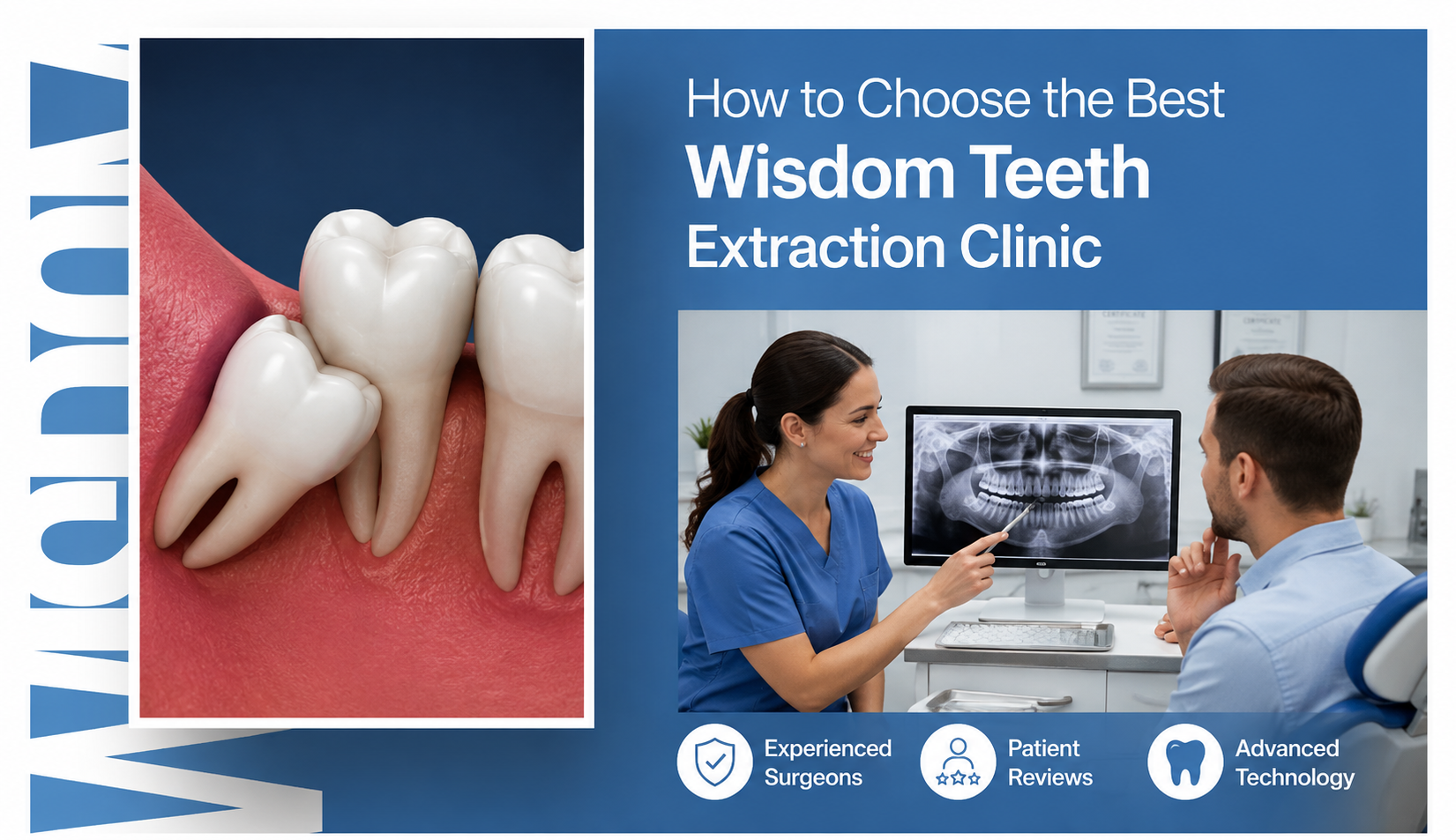
How to Choose the Best Wisdom Teeth Extraction Clinic
Choosing a wisdom teeth extraction clinic is not the same as choosing a dentist for a check-up. A clean, friendly practice that does excellent general dentistry may still only remove a handful of wisdom teeth a year. For a straightforward upper tooth, that is fine. For a lower tooth wedged sideways against your second molar with roots curled toward the nerve, it is not.
This guide sets out what to compare — practically, in the order it matters.
First, work out what kind of case you are
Your case type determines what the clinic needs to be able to do.
Simple. Fully erupted, straight, visible in the mouth, normal roots. Removed with forceps under local anaesthetic in 15 to 30 minutes. Almost any general dental clinic handles this.
Surgical. Partly erupted or covered by gum and bone. Needs a small incision, sometimes bone removal, sometimes sectioning the tooth into pieces. I want a clinic that does this routinely.
Complex. Deeply impacted, wisdom tooth growing sideways into the neighbouring molar, roots hooked around the inferior alveolar nerve, or all four coming out in one sitting. Wants a clinic with strong surgical experience and — ideally — sedation and general anaesthetic access.
You will not always know which you are, and that is fine. But a clinic that cannot tell you which you are after looking at an x-ray is not the right clinic.
The imaging test
Any clinic worth booking will take or request an OPG — a panoramic film showing all four wisdom teeth, their angles, root shapes and their relationship to the nerve canal and the maxillary sinus. In a minority of cases, where the roots appear to overlap the nerve canal, a CBCT gives the three-dimensional detail needed to plan safely.
The test is simple: does the clinic look before it quotes? You can send us your OPG or full-mouth x-ray through our home page upload form and get an approximate cost before you attend.
Compare pricing properly, not on the headline number
Wisdom teeth removal cost in Melbourne legitimately varies. Ours is a useful example of the range: a straight, fully erupted wisdom tooth starts from around $200, while surgical removal of an impacted or horizontally growing tooth starts from around $300 and increases with the complexity of the case — bone removal, flap raising, sectioning, and the number of teeth all move the number.
When comparing clinics, ask each one the same five questions:
- Is the initial consultation charged separately, and is it credited if I proceed?
- Is the OPG included?
- Is the quote per tooth or for the whole treatment?
- What is the cost of sedation or general anaesthetic on top?
- Is the post-operative review included, and what happens if I get a dry socket?
A cheap per-tooth price with a separate consultation fee, separate x-ray fee, separate review fee and a surprise surgical loading is not cheap. Our full cost breakdown and our article on the average cost of wisdom tooth removal set out how the variables work.
Also ask about payment. Interest-free plans through DentiCare and similar providers let you spread the cost over three to twelve months without credit checks — see our payment options.
Sedation availability is a real differentiator
Plenty of clinics offer local anesthetics. Far fewer can offer the full ladder in-house:
| Option | Who it suits | Recovery |
| Local anaesthetic | Simple and many surgical cases | Drive yourself home |
| Nitrous oxide | Mild to moderate anxiety | Clears within minutes |
| IV sedation | Moderate to high anxiety, longer surgical cases | Need a driver, rest the day |
| General anaesthetic | All four impacted, severe anxiety, strong gag reflex, special needs | Need a driver and a carer for the day |
If you know you are anxious, choosing a clinic without sedation access means either enduring a procedure you dread or being referred elsewhere halfway through the process. Our Bayswater clinic is the sedation and general anaesthetic hub for our group — read more about sleep dentistry options for wisdom teeth removal in Melbourne, or the specifics of IV sedation and nitrous oxide.
Aftercare tells you what the clinic is really like
Extraction takes half an hour. Recovery takes a week. Clinics differ far more in the second part than the first.
What to look for:
- Written post-operative instructions, handed to you, not recited at the door
- A contact number that works after hours for the first few days
- A review appointment, included, at around a week
- A clear position on complications — who pays if you get a dry socket, and how quickly they will see you
Dry socket typically appears on day three to five as a deep, throbbing ache that painkillers barely touch, often with a bad taste. It is treatable in a single visit. What matters is whether you can get seen.
Our guide to reducing infection risk after a wisdom tooth extraction covers the aftercare we expect our patients to follow.
An infected tooth needs a clinic that will slow down
If you present with an infected wisdom tooth, the right clinic will often decline to extract it that day. Operating into an acute infection means local anaesthetic works less predictably and the tissues are inflamed and friable.
Better practice is to settle it first — irrigation, debridement, antibiotics where indicated, pain relief — then extract within one to two weeks once the swelling has gone. A clinic willing to have that conversation with you while you are in pain is showing you its judgement.
Location, hours and access
Wisdom teeth removal usually means three visits: consult, procedure, review. Add a driver if you have sedation. So consider:
- How far, and is there parking?
- Are they open on weekends, when flare-ups tend to happen?
- How quickly can they fit in an emergency?
- Is the same dentist doing all three visits?
Our three clinics — Springvale, Carrum Downs and Bayswater — are open 9am to 5pm seven days, which covers most of south-east and eastern Melbourne.
Questions to ask before you commit
Print these and take them with you. There is a longer version in our article on questions to ask your dentist before wisdom teeth extraction.
- How complex is my case, and why?
- How close are the roots to the nerve?
- What could change the plan on the day?
- What are the specific risks in my case?
- How long will I need off work?
- What is the total cost, itemised, in writing?
- Who removes the teeth, and how often do they do this?
First signs your wisdom teeth are coming in
Worth knowing so you can get assessed before it becomes urgent:
- A dull ache or pressure at the very back of the jaw
- Tender, puffy gum behind the last molar
- Food trapping in a spot that never trapped food before
- Jaw stiffness or difficulty opening fully
- A bad taste or persistent bad breath from one corner
- Headache or ear-area ache on one side
Most people notice these between 17 and 25. Early assessment does not commit you to extraction — it just means the decision gets made calmly rather than in an emergency.
Molar vs wisdom tooth — a quick clarification
Wisdom teeth are molars, specifically the third molars, the last of the three sets. They are the same in structure to your first and second molars. The differences are in timing (17 to 25 rather than childhood), space (usually not enough), root shape (frequently irregular or hooked) and cleanability (poor). Those four differences explain almost every problem wisdom teeth cause.
Frequently asked questions
1. How do I know if my case is complex?
An OPG answers it in seconds. Send us yours for an approximate assessment.
2. Is a specialist clinic always better?
Not necessarily, and it is usually more expensive. Experienced general dental clinics handle the great majority of wisdom teeth well. What matters is honest triage — the clinic recognising the cases that need a specialist and saying so.
3. How much does impacted wisdom teeth removal cost?
Surgical removal of an impacted tooth starts from around $300 per tooth and depends on the impaction. A firm figure requires an x-ray and consultation.
4. Can I have all four out at once?
Yes, and it is often the efficient choice — one recovery period instead of two or four. All four in one sitting is usually done under IV sedation or general anaesthetic.
5. How long is recovery?
Most people feel substantially better by day five to seven, with gum tissue healing over three to four weeks. Take two to three days off for a surgical case.
Compare us on the things that matter
Springvale Dental Clinic — Shop 22, 792 Heatherton Road, Springvale South VIC 3172 · (03) 9546 0011
Carrum Downs Dental Group — Shop T5, 100 Hall Road, Carrum Downs VIC 3201 · (03) 9782 1200
Bayswater Dentist — 664 Mountain Hwy, Bayswater VIC 3153 · (03) 9069 3100 — sedation and general anaesthetic hub
Open 9am–5pm, seven days. Upload your OPG for a rough quote · See costs · Meet our dentists