
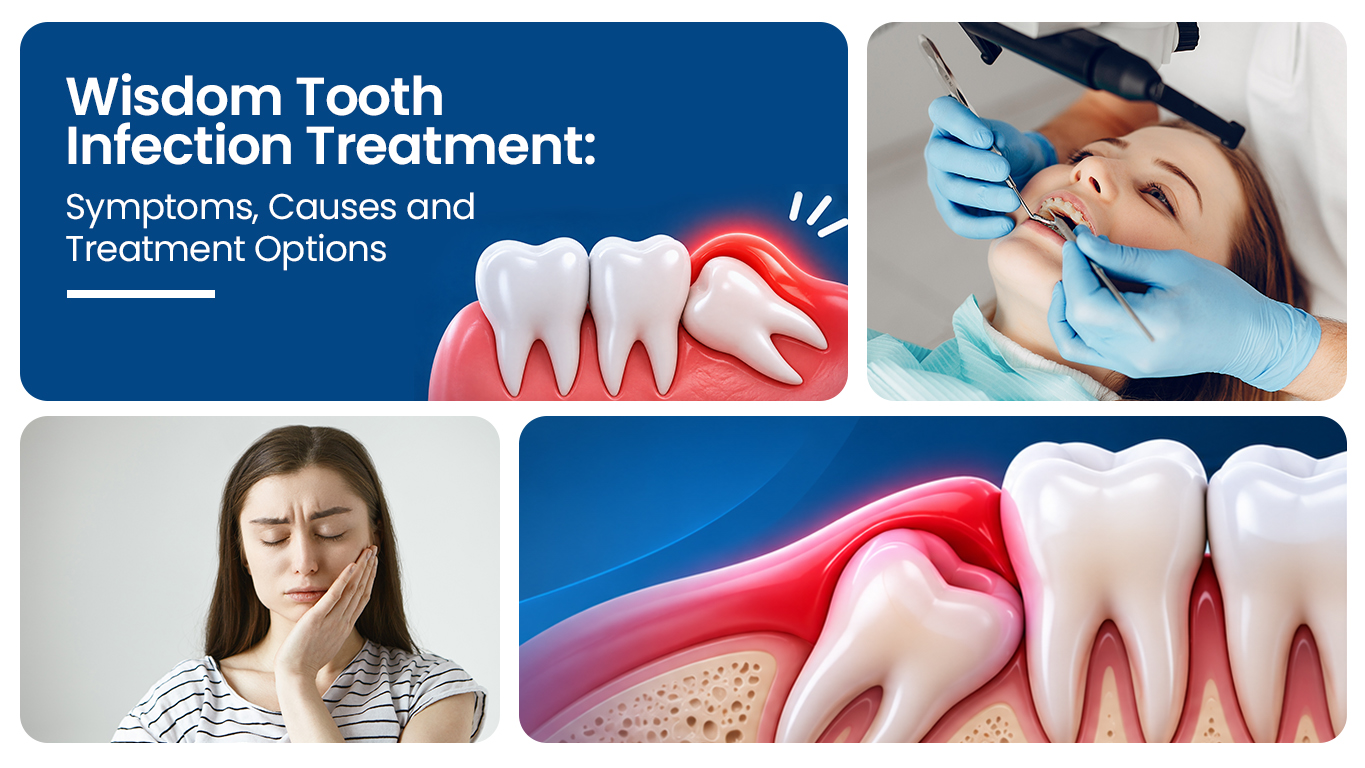
Wisdom Tooth Infection Treatment: Symptoms, Causes and Treatment Options
A wisdom tooth infection is the most common reason people walk into our Springvale, Carrum Downs and Bayswater clinics without an appointment. It usually starts as a tender, swollen pad of gum at the very back of the lower jaw, gets steadily worse over two or three days, and by the time it hurts to swallow most people have decided they want the tooth gone today.
Sometimes that is the right call. More often the right treatment is to settle the infection first and remove the tooth a week or two later. This article explains why, and what each step involves.
Why wisdom teeth get infected when other molars don’t
A wisdom teeth dentist will tell you that a wisdom tooth is just a third molar — structurally the same as the two molars in front of it. The difference is position. It is the last tooth to arrive, usually between 17 and 25, and in most Australian jaws there is not quite enough room for it. So it comes through partially, at an angle, or not at all.
A partially erupted tooth has a flap of gum (the operculum) sitting over part of its crown. Food & bacteria collect underneath, your toothbrush cannot reach, and the flap becomes inflamed. That is pericoronitis — by far the most common form of wisdom tooth infection. Our infected wisdom tooth symptoms article goes through how to recognise it.
Less commonly, the infection comes from decay in the wisdom tooth itself or the molar in front of it, or from an abscess at the root tip.
Symptoms that tell you it is infected, not just erupting
- Swollen, red, tender gum behind the last molar
- Pain on biting, as the opposing tooth presses on the swollen flap
- A bad taste or smell, sometimes visible pus
- Difficulty opening your mouth fully (trismus)
- Pain spreading to the ear, jaw or throat on one side
- Swollen glands under the jaw
- In more advanced cases, facial swelling, fever and feeling unwell
How we treat a wisdom tooth infection
Step 1 — Assess and image.
We examine the area and take an OPG if you do not have a recent one. The x-ray tells us whether the tooth is going to come through properly (in which case the infection may be a one-off) or is impacted (in which case it will keep recurring).
Step 2 — Settle the infection.
For most pericoronitis the first treatment is local: irrigating under the gum flap to flush out trapped debris, gently cleaning the area and sometimes trimming or dressing the flap. We will give you a chlorhexidine or warm salt-water rinse routine and advise on pain relief. This alone resolves a lot of mild cases within a few days.
Step 3 — Antibiotics, when they are warranted.
Antibiotics are not automatic. We prescribe them when there is spreading swelling, fever, swollen glands, pus that will not drain, or a patient whose immune system is compromised. Used that way they work well. Used for every sore gum they stop working for the people who need them.
Step 4 — Decide what happens to the tooth.
This is where the x-ray earns its keep:
- The tooth is upright with room to erupt: we may simply monitor it. Occasionally removing the gum flap alone (an operculectomy) stops the problem.
- The tooth is impacted or has had more than one infection: extraction is the only permanent fix. We usually schedule it one to two weeks after the infection has settled, when the tissue is less inflamed, the anaesthetic works more predictably and healing is more reliable.
- The upper wisdom tooth is biting onto the swollen gum: sometimes removing the upper tooth first gives immediate relief and buys time.
Step 5 — Extraction.
Once settled, the tooth is removed under local anaesthetic, nitrous oxide, IV sedation or general anaesthetic depending on the difficulty and your preference. GA cases go to the day-surgery facility at our Bayswater clinic. Our treatment page covers the procedure itself.
When immediate extraction is the right answer
If the infection is confined, the tooth is accessible and you are otherwise well, extracting on the day is reasonable and we do it. The reason we do not do it for everyone is practical: operating into acutely inflamed tissue is harder to numb, bleeds more, heals slower and carries a higher risk of post-operative infection and dry socket. A short delay is not us being cautious for the sake of it; it is usually the faster route to getting comfortable again.
Why are dentists so expensive? (A fair question)
People in pain often ask this, so here is a straight answer. Dental care in Australia is largely private — Medicare does not cover adult dental treatment except in limited circumstances — and a surgical extraction involves a registered dentist, a trained assistant, single-use sterile instruments, imaging, anaesthetic and a fully equipped surgery for 30–60 minutes. That is the cost base.
What we can do is be transparent and keep it manageable:
- Consultation $50, with the quote in writing before anything is done
- Simple extraction 150–200; impacted surgical extraction 200–450 per tooth — our wisdom teeth removal cost Melbourne-wide is the same at all three clinics
- Free post-treatment review
- HICAPS on-the-spot claiming for health fund extras; we are preferred providers for several funds
- Interest-free payment plans through DentiCare, Humm and Afterpay — see payment options
If you want to understand the pricing in more depth, our article on the cost of wisdom tooth removal breaks it down.
A note on pregnancy
Hormonal changes make pericoronitis more likely and more painful during pregnancy, and treatment is adjusted — some antibiotics and painkillers are avoided, and elective extraction waits until after delivery while urgent treatment goes ahead. If that is your situation, our dedicated guide to wisdom tooth pain during pregnancy covers it properly.
Frequently asked questions
1. Can a wisdom tooth infection go away on its own?
Mild pericoronitis sometimes settles with meticulous cleaning and salt-water rinses. If the tooth is impacted, though, the conditions that caused it have not changed and it will come back — usually worse. Have it assessed.
2. Will antibiotics fix my wisdom tooth infection?
They can control the infection but they do not fix the cause. If the tooth is impacted, you will be back.
3. How quickly can I be seen?
All three of our clinics are open 9am–5pm seven days a week, and we prioritise patients in pain. Call the nearest clinic — for wisdom teeth extraction Mulgrave, Clayton, Keysborough and Dandenong patients come to Springvale; for wisdom tooth extraction Cranbourne, Clyde North, Frankston South and Seaford patients come to Carrum Downs; and Boronia, Wantirna, Ringwood and the Knox area at Bayswater.
4. Is it a normal molar or a wisdom tooth that is hurting?
If the pain is behind your last big molar and you are under about 30, it is most likely a wisdom tooth. An x-ray settles it in seconds. Our article on wisdom tooth vs normal tooth explains the differences.
5. When is a wisdom tooth infection an emergency?
Facial swelling that is spreading, difficulty swallowing or breathing, or a fever with a rigid, swollen neck — go to a hospital emergency department immediately. Everything short of that, call us.
Book a wisdom teeth assessment in Melbourne
If a wisdom tooth is flaring up, do not wait for it to settle on its own. Call your nearest clinic, or email your OPG for advice and an approximate cost.
Springvale Dental Clinic — Shop 22, 792 Heatherton Road, Springvale South VIC 3172 · (03) 9546 0011
Carrum Downs Dental Group — Shop T5, 100 Hall Road, Carrum Downs VIC 3201 · (03) 9782 1200
Bayswater Dentist — 664 Mountain Highway, Bayswater VIC 3153 · (03) 9069 3100
Open 9am–5pm, seven days. Bayswater is our sedation and general anaesthetic hub. Meet our dentists · Payment plans