
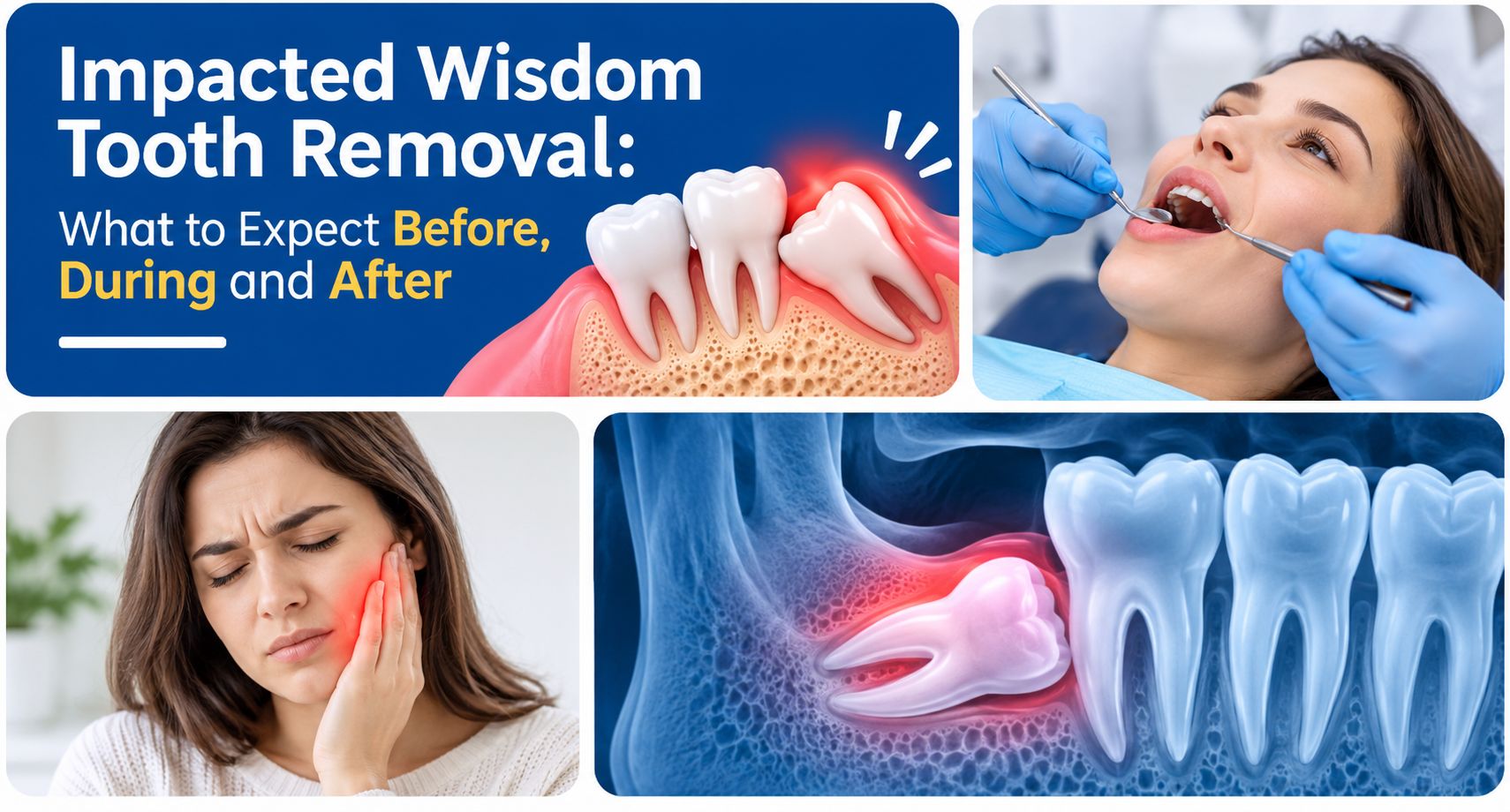
Impacted Wisdom Tooth Removal: What to Expect Before, During and After
“Impacted” is the word that turns a routine extraction into a surgical one, and it is the word that worries patients searching for wisdom teeth removal in Melbourne most. It simply means the tooth has not come through into its normal position — it is blocked by bone, gum, the tooth in front, or all three. This article explains what that means for how the tooth is removed, what your anaesthetic choices are, and what the days afterwards look like, based on how we handle impacted wisdom tooth removal at our Springvale, Carrum Downs and Bayswater clinics.
(And, since people ask: why are they called wisdom teeth? Because they arrive between roughly 17 and 25 — the age at which you are supposedly wiser than you were when the rest of your teeth came in. The jury is still out.)
The four types of impaction
Your OPG tells us which one you have, and each is removed a little differently:
Mesioangular — the most common. The tooth leans forward into the second molar. It traps food against the neighbour and is the classic cause of decay in the molar in front. Usually a moderate surgical extraction.
Horizontal — the tooth lies flat, often with its crown wedged under the second molar. Almost always needs sectioning and some bone removal. The most involved of the four, but very routine.
Vertical — upright but stuck below the gum or bone. Often the simplest surgical removal, sometimes not much harder than a standard extraction.
Distoangular — the tooth leans backwards, away from the molars, towards the jaw joint. Deceptively awkward, particularly in the lower jaw, because the roots sit deep.
Impaction is also graded as soft-tissue (gum only), partial bony or complete bony, which largely determines how much bone, if any, needs to be removed. Our article on wisdom tooth impaction goes into the diagnosis side.
Before: the assessment
Everything starts with the OPG. For lower impacted teeth we look closely at the relationship between the roots and the inferior alveolar nerve canal; where they appear to overlap we may recommend a CBCT scan for a 3D view before deciding on the approach. We also check the second molar for decay, the surrounding bone for cysts, and your general health and medications.
You leave the consultation ($50) with a written quote — impacted teeth are 200–450 depending on complexity — and a clear recommendation on anaesthetic. Very deep impactions or roots wrapped around the nerve may be referred to an oral and maxillofacial surgeon; we will tell you plainly if that applies.
Dentist anaesthesia options for a surgical extraction
Choosing the anaesthetic for an impacted tooth is about comfort, duration and how many teeth are being done.
- Local anaesthetic. Perfectly adequate for a single impacted tooth in a calm patient. The procedure takes 20–45 minutes and you drive home.
- Nitrous oxide (happy gas). Local anaesthetic plus a gas that takes the edge off. Wears off within minutes.
- IV sedation. Twilight sedation given through a cannula by a sedationist. Ideal for one or two impacted teeth in an anxious patient. You will need someone to take you home.
- General anaesthetic. Asleep throughout. The standard recommendation for all four impacted teeth in one visit, for a strong gag reflex, severe anxiety, or patients with additional needs. Our GA cases are performed at Advanced Sleep Dental Solutions, the day-surgery facility at our Bayswater site, with a specialist anaesthetist team — patients from Springvale and Carrum Downs are booked there. A portion of the anaesthetist’s fee attracts a Medicare rebate.
Our sleep dentistry guide compares them in more depth.
During: how an impacted tooth is removed
Once you are numb or asleep:
- Access. A small incision in the gum behind the second molar and the gum lifted aside as a flap.
- Bone removal, if needed. A fine surgical handpiece with water cooling removes the thin shelf of bone over the crown. You feel vibration and pressure, not pain.
- Sectioning. The tooth is divided — typically into crown and roots, sometimes the roots are separated too — so each piece can be lifted out along its own path without forcing against bone or the nerve. This is why sectioning makes the procedure gentler, not rougher.
- Delivery. Each piece is elevated out.
- Clean and close. The socket is irrigated, any follicle tissue removed, and the flap stitched back. We generally use dissolving stitches.
A single lower impacted tooth is usually 30–45 minutes; all four under GA about an hour to ninety minutes in theatre, after which you spend time in recovery before going home. Our detailed walkthrough of the process of impacted wisdom teeth removal has more.
After: what recovery from a surgical extraction really looks like
Surgical extractions heal a little slower than simple ones because bone has been involved. A realistic timeline:
- Day 0: numb for 2–4 hours; bite on gauze; start pain relief early; soft, cool food; rest. No straws, rinsing, smoking or alcohol for 24 hours.
- Days 1–3: swelling peaks at day two or three, often with some bruising on the cheek or neck after lower teeth. Cold packs day one, then warm salt-water rinses after meals from day two. Jaw stiffness is normal — gentle opening exercises help.
- Days 3–5: pain should be easing. If it worsens instead, with a bad taste and pain towards the ear, suspect dry socket and call us.
- Days 7–10: most people are eating normally. Stitches dissolve or are removed at your free review.
- Weeks 2–6: gum closes over; bone fills in beneath over the following months.
Our guides on swelling after wisdom teeth removal and reducing infection risk are worth reading before the day.
Risks worth knowing about
Dry socket is the most common complication, affecting a meaningful minority of lower extractions, more so in smokers; it is uncomfortable but treatable. Temporary altered sensation in the lip, chin or tongue can follow lower extractions where the nerve is close — most cases resolve over weeks, and the risk is why we image carefully beforehand. Infection, prolonged bleeding and a small opening into the sinus after upper extractions are all uncommon and manageable. We discuss the specific risks for your tooth at the consultation, not in general terms.
Frequently asked questions
Is impacted wisdom tooth removal painful?
The procedure should not be, with adequate anaesthetic. Afterwards, expect two to four days of soreness that responds to pain relief and improves daily.
How long should I take off work?
One to two days for a single lower impacted tooth under local; two to three days for four teeth under GA. Avoid heavy exercise for about a week.
Will my face swell?
Usually, peaking at day two or three and resolving over about a week. Cold packs on day one make a real difference.
Do I need an oral surgeon?
Most impacted wisdom teeth are removed by experienced general dentists. We refer the small number of cases that are safer in a hospital setting.
Which clinic should I go to?
Any of the three for assessment and local-anaesthetic extractions — Springvale for wisdom teeth removal Springvale, Keysborough, Clayton and Dandenong patients; Carrum Downs for the Frankston and Cranbourne corridor; Bayswater for wisdom teeth removal Ferntree Gully, Boronia, Wantirna and Ringwood patients. Sedation and GA cases are booked at Bayswater regardless of where you were assessed.
Book a wisdom teeth assessment in Melbourne
Been told you have an impacted wisdom tooth? Email or upload your OPG and we will tell you how we would remove it, which anaesthetic we would suggest and what it would cost.
- Springvale Dental Clinic — Shop 22, 792 Heatherton Road, Springvale South VIC 3172. (03) 9546 0011
- Carrum Downs Dental Group — Shop T5, 100 Hall Road, Carrum Downs VIC 3201 · (03) 9782 1200
- Bayswater Dentist — 664 Mountain Highway, Bayswater VIC 3153 · (03) 9069 3100
Open 9am–5pm, seven days. Bayswater is our sedation and general anaesthetic hub. Treatment details · Costs