
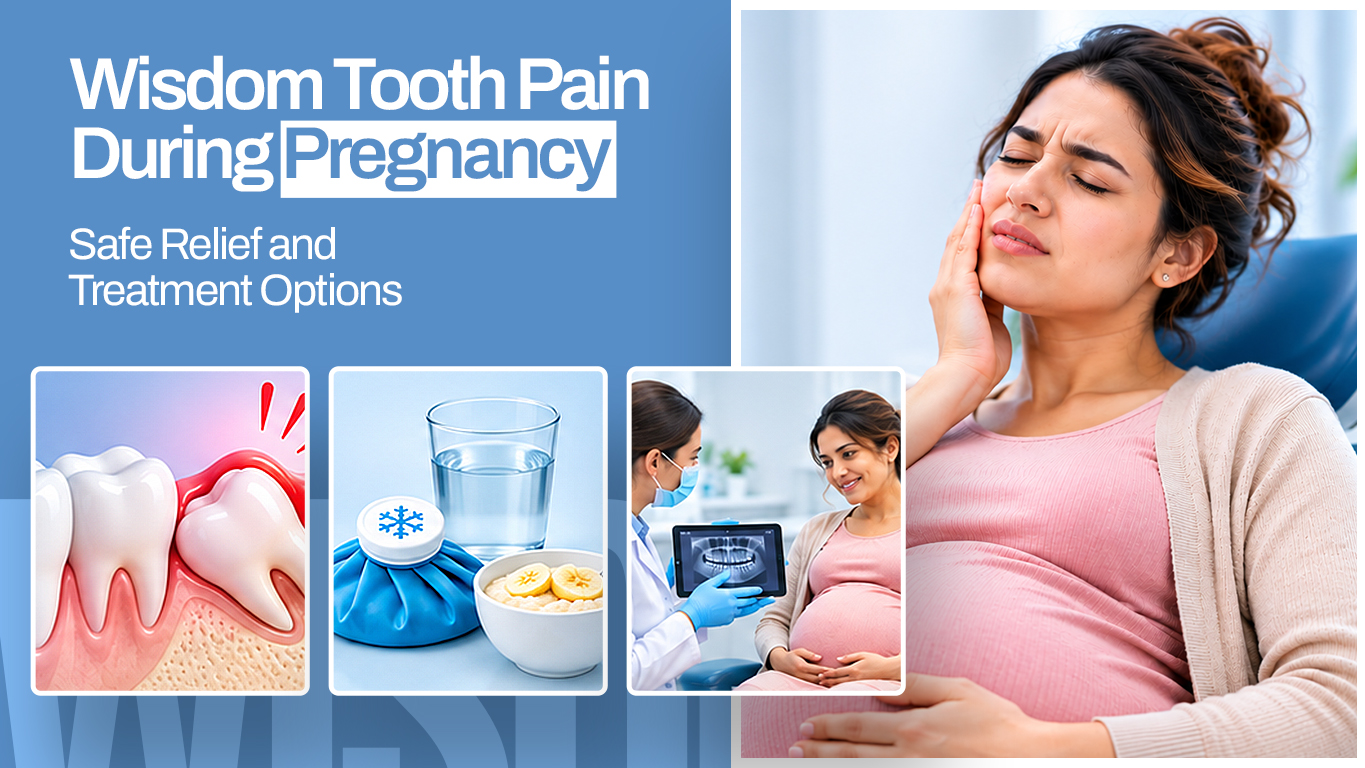
Wisdom Tooth Pain During Pregnancy: Safe Relief and Treatment Options
Wisdom tooth pain in pregnancy catches people out. If you are pregnant and a wisdom tooth has started to ache, two things are probably true: it hurts more than you expected, and you are unsure what you are allowed to take for it. This guide is the practical companion to our earlier article on whether a wisdom tooth can be removed while pregnant. That one covers the decision; this one covers getting you comfortable — tonight, this week, and for the rest of the pregnancy.
Why wisdom tooth pain flares in pregnancy
Rising progesterone and oestrogen exaggerate the gum’s response to plaque, so the already hard-to-clean gum flap over a partially erupted wisdom tooth inflames easily. Morning sickness brings stomach acid and makes brushing at the back of the mouth trigger gagging, so that corner gets cleaned less. More snacking and disturbed sleep add to it. The result is pericoronitis — infection under the gum flap — often appearing or recurring from the second trimester onwards.
How to relieve wisdom tooth pain while pregnant: what you can do tonight
These are generally considered appropriate at any stage of pregnancy and work well for pericoronitis:
- Warm salt-water rinse. Half a teaspoon of salt in a cup of warm water, swished and held at the back for 30 seconds, after every meal and before bed. This is the single most effective home measure.
- Cold compress. A wrapped ice pack on the cheek, 15 minutes on, 15 off. Not heat — warmth on a swollen face tends to increase the swelling.
- Clean the area gently. A child-size or single-tuft toothbrush reaches behind the last molar without triggering the gag reflex as badly. Even if it stings, getting debris out from under the flap matters.
- Sleep propped up. An extra pillow reduces the throbbing that builds when you lie flat.
- Soft, cool foods. Avoid chewing on that side and skip anything hard, sharp or sugary.
- Avoid: neat clove oil on the gum, aspirin tablets held against the tooth, alcohol-based mouthwashes, and any “remedy” you have not checked with your midwife or GP.
Pain relief: what is considered safe
Always confirm with your GP, obstetrician, midwife or pharmacist before taking anything — including things already in your cupboard. In general terms:
- Paracetamol is the first-line pain reliever in pregnancy at standard doses and is used throughout all three trimesters.
- Ibuprofen and other anti-inflammatories (NSAIDs) are generally avoided, particularly from 20 weeks and definitively in the third trimester, because of effects on the baby’s circulation and amniotic fluid.
- Aspirin should not be used for dental pain in pregnancy unless your doctor has prescribed it for another reason.
- Antibiotics, where there is a genuine infection, are commonly used in pregnancy — amoxicillin is a frequent choice. Some, including doxycycline and other tetracyclines, are avoided. Your dentist will coordinate with your GP or obstetrician if there is any doubt.
What a dentist can do for you during pregnancy
Quite a lot, and the sooner the better. At our Springvale, Carrum Downs and Bayswater clinics a pregnant patient with wisdom tooth pain is typically managed like this:
- Examination, with an x-ray only where it genuinely changes treatment. A dental x-ray with a lead apron and thyroid collar delivers an extremely small dose directed well away from the abdomen; where it can wait, it waits.
- Irrigation and cleaning under the gum flap to remove the trapped debris that is driving the infection. This gives most patients noticeable relief within 24 hours.
- A rinse routine and pain-relief plan that fits your trimester.
- Pregnancy-appropriate antibiotics if there is spreading infection.
- A decision on the tooth. If the infection settles and you are not far from delivery, we monitor and plan the extraction for afterwards. If it keeps coming back, extraction under local anaesthetic in the second trimester is the preferred window.
Can you get your wisdom teeth removed while pregnant?
Yes, when it is necessary. Untreated dental infection carries more risk to a pregnancy than carefully managed treatment. The second trimester (roughly weeks 14–27) is preferred for anything surgical: organ development is complete, nausea has usually eased, and lying back is still comfortable. Elective removal of a wisdom tooth that is not causing problems waits until after the baby arrives.
Local anaesthetic is the anaesthetic of choice and is considered safe. Nitrous oxide, IV sedation and general anaesthetic are normally deferred until after delivery, which means that for pregnant patients we treat under local only — and we adjust appointment length and positioning (slightly on your left side in later pregnancy) to keep you comfortable. Our companion article covers the remove-now-or-wait decision in more detail.
Symptoms that mean “call today, not next week”
- Swelling of the cheek, jaw or under the chin
- Pus or a persistent bad taste
- Difficulty opening your mouth or swallowing
- Fever or feeling generally unwell
- Pain stopping you eating or sleeping
Facial swelling with difficulty swallowing or breathing is an emergency — go to a hospital emergency department.
A word on cost
Pregnancy is expensive enough, and people often ask why dental work costs what it does even with insurance. Adult dental care in Australia is largely private, and extras cover pays a fixed benefit per item rather than a percentage of the bill. What we can control is clarity: a $50 consultation, a written quote before any treatment, HICAPS on-the-spot claiming, and interest-free payment plans if you prefer to spread the cost. Infection management during pregnancy is usually a modest cost; the extraction itself can often be planned, and budgeted, for after the birth.
Frequently asked questions
Is it safe to see a dentist while pregnant?
Yes, and recommended. Tell the clinic you are pregnant and how many weeks when you book.
Can wisdom tooth infection harm my baby?
Untreated oral infection has been associated with pregnancy complications in some studies, which is one reason not to leave it. Prompt, conservative treatment is the lower-risk path.
What if the pain is in the first trimester?
We still see you. Treatment is kept conservative — cleaning, rinses, paracetamol, antibiotics only if clearly needed — and anything surgical is planned for the second trimester or after delivery unless it cannot wait.
Can I have the tooth out straight after the baby is born?
Usually yes, including under sedation or GA at our Bayswater day-surgery facility if you prefer to be asleep. If you are breastfeeding, tell us so medications can be chosen accordingly.
Which clinic should I call?
Whichever is closest. Springvale serves Springvale South, Mulgrave, Keysborough and Clayton (wisdom tooth removal Mulgrave patients are about ten minutes away); Carrum Downs serves Cranbourne, Cranbourne South and West, Sandhurst, Frankston and Seaford; Bayswater serves the Knox and Maroondah area.
Book a wisdom teeth assessment in Melbourne
Pregnant and in pain? Call us today — we will fit you in, settle the infection and make a plan that suits your stage of pregnancy.
Springvale Dental Clinic — Shop 22, 792 Heatherton Road, Springvale South VIC 3172 · (03) 9546 0011
Carrum Downs Dental Group — Shop T5, 100 Hall Road, Carrum Downs VIC 3201 · (03) 9782 1200
Bayswater Dentist — 664 Mountain Highway, Bayswater VIC 3153 · (03) 9069 3100
Open 9am–5pm, seven days. Meet our dentists · See our FAQ