
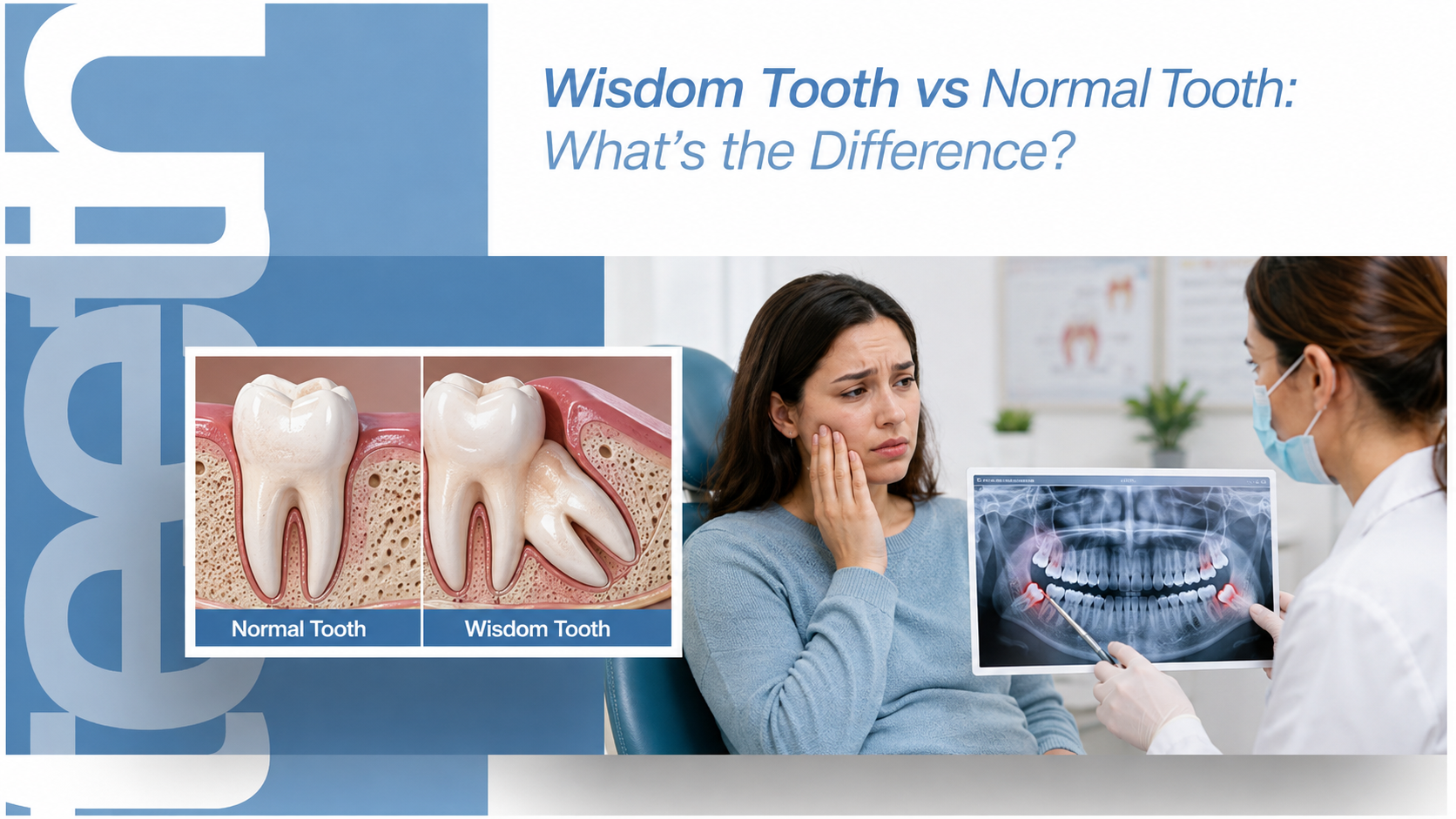
Wisdom Tooth vs Normal Tooth: What’s the Difference?
If a wisdom tooth is just another molar, why does it cause so much more trouble than the rest of your teeth? People rarely have their first molars removed preventively. Wisdom teeth get removed by the million.
The answer to wisdom tooth vs normal tooth is not that they are built differently. It is that they arrive late, in the wrong place, with awkward roots, in a jaw that has already run out of room.
What is a wisdom tooth, technically?
Wisdom teeth are the third molars — the last four teeth at the very back, one in each corner. Adults have 32 teeth when all are present: 8 incisors, 4 canines, 8 premolars and 12 molars, of which four are wisdom teeth.
Structurally, a wisdom tooth is a molar. Same enamel, same dentine, same pulp, same broad chewing surface designed for grinding. If it erupts straight, in the right place, with enough room and access to a toothbrush, it works exactly like your other molars and should be left alone.
That is the important caveat. Not every wisdom tooth is a problem tooth.
The five real differences
- Timing. Every other adult tooth arrives between about six and thirteen. Wisdom teeth arrive between 17 and 25 — after the jaw has finished growing and after the other 28 teeth have settled into position. They are turning up to a full room.
- Space. Modern human jaws are smaller than our ancestors’, while the number of teeth has not changed. There is frequently not enough room in the arch. A first molar erupts into space that was waiting for it. A wisdom tooth erupts into whatever is left, which is often nothing.
- Root shape. First and second molars usually have reasonably predictable roots. Wisdom tooth roots are notoriously variable — sometimes fused into a cone, sometimes splayed, sometimes hooked, sometimes curved around the inferior alveolar nerve in the lower jaw or projecting into the maxillary sinus above. This is what makes removing a wisdom tooth less predictable than removing a normal one.
- Position and cleanability. Even a well-positioned wisdom tooth sits at the back of the mouth where a toothbrush arrives at an awkward angle and floss is a genuine skill. Plaque accumulates. Decay and gum disease follow — often on the back of the second molar, which is the tooth you actually wanted to keep.
- Consequences of failure. If a normal tooth develops a problem, you generally restore it — filling, crown, root canal. If a wisdom tooth develops a problem, extraction is usually the sensible answer, because restoring a tooth you cannot clean and do not need for chewing rarely makes sense.
Comparison at a glance
| Normal tooth (first/second molar) | Wisdom tooth (third molar) | |
| Erupts | Age 6–13 | Age 17–25, if at all |
| Space available | Planned for | Usually insufficient |
| Root anatomy | Fairly predictable | Highly variable, often hooked |
| Cleanability | Reasonable | Poor |
| Needed for chewing | Yes | Rarely |
| Usual answer to a problem | Restore it | Remove it |
| Risk when extracting | Low | Nerve proximity, sinus proximity, bone removal |
Impaction: the difference that matters most
A tooth is impacted when it cannot erupt into its normal position. Almost nobody has an impacted first molar. Impacted wisdom teeth are common.
The main patterns:
- Mesial impaction — angled forward toward the second molar. The most common type.
- Horizontal impaction — lying flat, growing sideways directly into the second molar. Often the most destructive.
- Vertical impaction — upright but stuck below the gum or bone.
- Distal impaction — angled backwards toward the rear of the jaw.
A wisdom tooth growing sideways into the cheek — angled outward — is a variant that produces a specific misery: repeated ulceration where the cusp rubs the cheek lining, and cheek biting that never quite heals. It is one of the clearer indications for removal.
Impacted wisdom teeth risks
Left in place, a problematic impacted wisdom tooth can produce:
- Pericoronitis — recurrent infection under the gum flap, which tends to come back
- Decay in the second molar — where the wisdom tooth presses against it, creating an uncleanable trap. This is the one that costs you a healthy tooth.
- Gum disease and bone loss behind the second molar
- Cysts — a dentigerous cyst can form around a buried tooth and slowly hollow out bone. Uncommon, but it is why buried teeth get monitored.
- Resorption of the neighbouring root
- Referred pain — jaw, ear and neck. See our article on wisdom teeth and jaw pain.
- Sinus problems from upper wisdom teeth — see the connection between wisdom teeth and sinus issues.
Not every impacted tooth does any of this. Plenty sit quietly for decades. That is why the modern position is selective removal based on findings, not automatic removal of all four.
Why removing a wisdom tooth is different from removing a normal tooth
A normal tooth extraction is usually forceps and controlled pressure.
A wisdom tooth extraction — particularly a lower impacted one — often involves:
- Raising a small gum flap
- Removing a little overlying bone
- Sectioning the tooth into pieces so each root can come out along its own path
- Suturing the site closed
This is why the process of impacted wisdom teeth removal takes longer, costs more, and carries risks that a normal extraction does not — chiefly temporary numbness of the lip, chin or tongue from proximity to the nerve, and a small communication into the sinus for upper teeth. Both are usually temporary and both are far less likely when the case is properly imaged and planned.
Side effects of dental anaesthesia
Local anesthetics are very safe. Common, self-limiting effects:
- Numbness lasting two to five hours, occasionally longer
- A brief racing heartbeat from the adrenaline in the solution
- Tenderness at the injection site for a day or two
- Accidental lip or cheek biting while numb — a real risk in children
Uncommon: prolonged numbness from direct nerve contact, which usually resolves over weeks to months. True allergy to modern local anaesthetics is rare.
With IV sedation or general anaesthetic, expect grogginess, occasional nausea, and no driving for 24 hours. Both are delivered by appropriately trained practitioners with monitoring.
What is the maximum age to get wisdom teeth removed?
There is no maximum age. There is, however, an easier window.
The ideal time is late teens to mid-twenties, when the roots are not fully formed, the bone is more elastic and healing is quick. From the mid-thirties onward the roots are complete, the bone is denser, and recovery is slower — a week rather than a few days.
Older patients absolutely still have wisdom teeth removed, particularly where there is infection, decay in the neighbouring molar, or a denture to be fitted. The decision shifts toward “is this tooth causing a problem now?” rather than “might it cause one later?”. See our article on whether age matters for wisdom teeth removal.
Do you need a wisdom teeth specialist?
Most wisdom teeth — including many impacted ones — are removed by experienced general dentists. Referral to an oral and maxillofacial surgeon is appropriate for very deep impactions, roots intimately involved with the nerve canal, significant medical complexity, or where hospital general anaesthetic is required.
If you are searching for a “wisdom teeth specialist near me”, start by getting an OPG and an honest read on your case. It is often simpler than you fear.
Frequently asked questions
Are wisdom teeth just extra molars?
Yes — they are third molars. The problems come from timing, space and position, not from being a different kind of tooth.
Can I keep my wisdom teeth?
If they are fully erupted, upright, cleanable and causing no problems, yes. We only recommend removal where they are impacted, infected, decaying or damaging the tooth in front. See when extraction is not necessary.
Does everyone have four?
No. Somewhere around a quarter of people are missing at least one, and some have none at all.
Is removing a wisdom tooth more painful than a normal extraction?
The procedure itself is not — you are numb either way. Recovery from a surgical wisdom tooth extraction typically involves more swelling and a few more days of soreness.
Will removing them change my face or bite?
No. Wisdom teeth sit behind the functional bite and removing them does not alter facial shape or how your teeth meet.
Not sure what you are dealing with?
Send us your OPG and we will tell you whether your wisdom teeth are the kind worth watching or the kind worth removing.
Springvale (03) 9546 0011 ·
Carrum Downs (03) 9782 1200 ·
Bayswater (03) 9069 3100 — sedation and general anaesthetic hub. Open 9am–5pm, seven days.